COMPANY
Areas of technology
Suction line
Compressor line
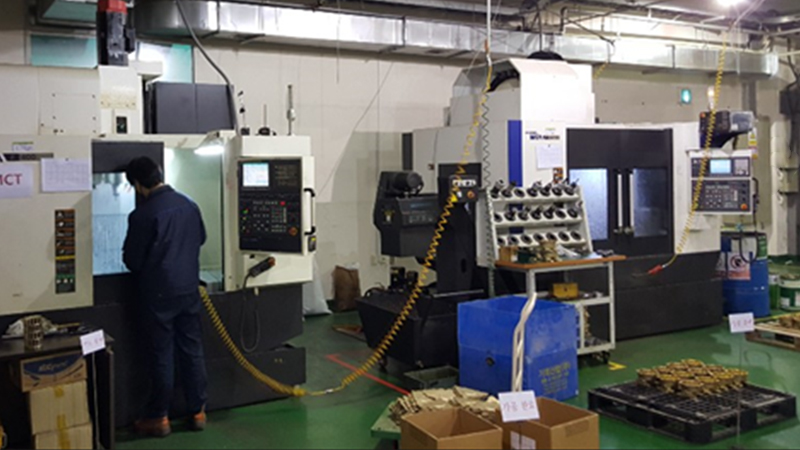
MCT (machining center)
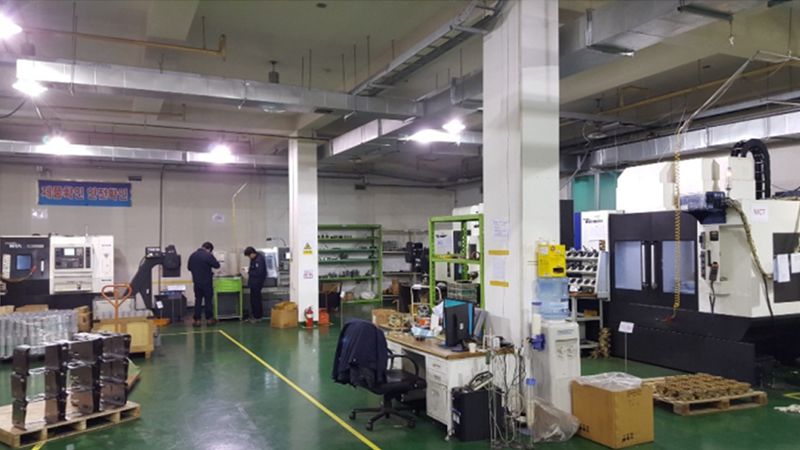
Processing production line
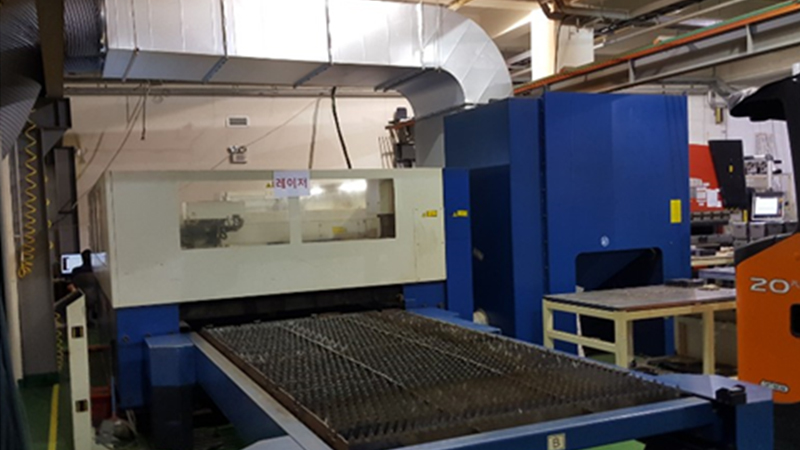
Laser processor
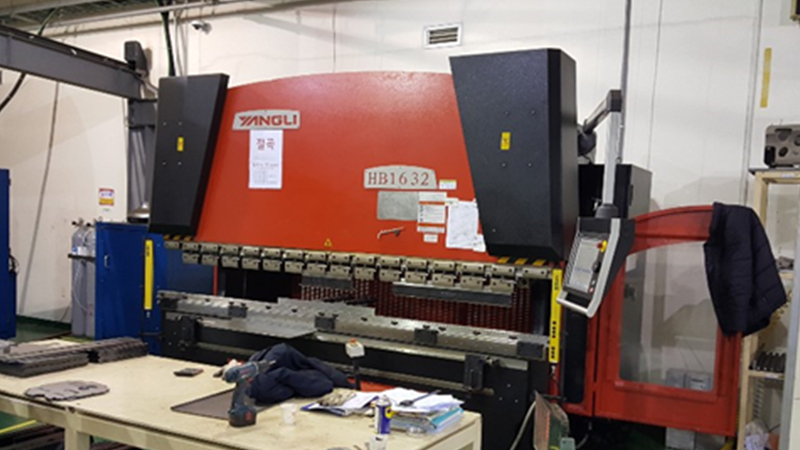
Bender and sheet metal machine
| Commercialized items | Purpose of items | Quality and price competitiveness |
|---|---|---|
| Dry suction machines (all models) |
For individually owned dental clinics |
Developed with a lower unit product cost than those of competitors’, 30 than Germany’s Durr and 20 than Italy’s Cattani, and fixed existing weaknesses |
| Large-capacity suction machines (Teramax) |
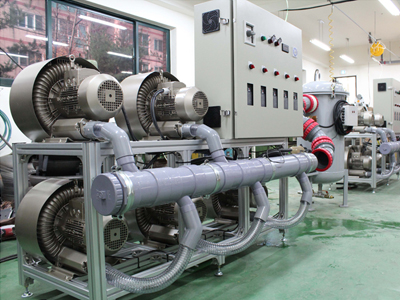
Centralized type for large-sized hospitals | Has a unit product cost about 50 lower than that of a competitor, Germany’s Durr, and applies the inverter control method, which competitors have not yet used, to improve motor efficiency and product life expectancy |
| Oil-Free compressors |
For individually owned dental clinics |
Possesses cost competitiveness with a lower unit product cost than those of competitors’, 40 than Germany’s Durr and 20 than Italy’s Cattani, and applies the membrane type utilized in the latest air dryers |
| Dry suction machines (all models) |
For individually owned dental clinics |
Developed with a lower unit product cost than those of competitors’, 30 than Germany’s Durr and 20 than Italy’s Cattani, and fixed existing weaknesses |
※ 80% of the current dry suction market is dominated by Germany’s Durr Dental and Italy’s Cattani but, by localizing all processes and providing competitive products with equivalent quality, DMEGA already serves a leading role in the domestic market.
The history of suctions is divided into the first-generation air suctions that often experienced petty malfunctions, the second-generation wet suctions and the third-generation dry suctions. The first-generation air suctions were used for only a short period of time as frequent malfunctions led to difficulties in usage but wet suctions do not experience such breakdowns in addition to being inexpensive and low in noise, which has made it the dominant market leader with nearly 80% share worldwide.
However, wet suctions are structurally designed in such a way that water is continuously flowing in through pipes in order to generate a suction force and, thus, pressure-generating tap water, mixed with various byproducts of dental treatments such as blood, pus and tissue, flows into a drain without any filtering device, which causes secondary environmental pollution.
Thanks to the development of dental treatment technology in recent years, simple tooth extraction or treatment of decayed teeth, which dominated dental care in the past, have evolved into more complex treatments such as implants and orthognathic surgeries. However, this has caused a significant increase in medical wastes generated during such treatments and the debate on the wash water continues to become more heated.
According to the already legislated Dentist Medical Waste Management Act, those who illegally throw away medical wastes are subject to imprisonment with prison labor for not exceeding two years or a fine not exceeding KRW 10 million. It costs about KRW 773,000/ton to dispose of medical wastes and, considering the amount of water used at a small- to medium-sized dental clinic is 4 tons, a cost over KRW 3 million must be paid every day. When calculated for a month assuming that there are 20 working days, KRW 61 million has to be paid monthly, which is practically an impossible amount to be paidby small- to medium-sized dental hospitals.
In fact, the amount of medical wastes typically discharged every day by a small- to medium-sized dental clinic both in Korea and overseas is between 4 to 10 tons, which is a great volume. Subsequently, many developed nations in Europe such as Germany have already realized the gravity of environmental pollution caused by wet suction and, thus, strictly prohibit its use, and what is widely being used as an alternative is the third-generation dry suction.
Introducing Products
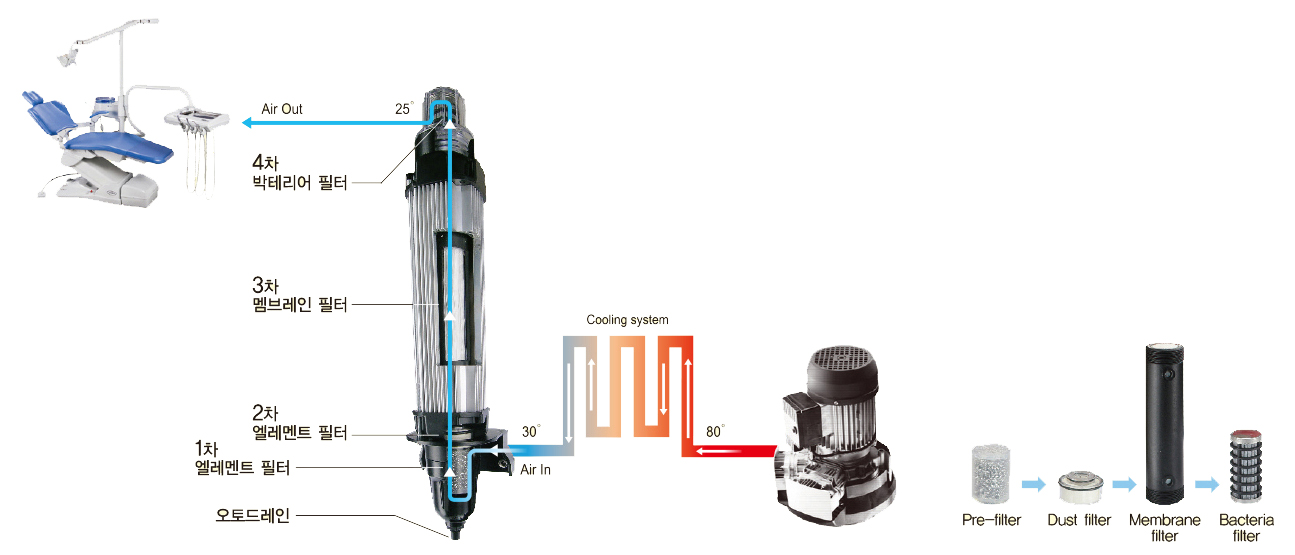
- Why do we have to use M-Brane Compressors?
- A typical compressor, despite the use of a dryer, supplies polluted air, which contains moisture, fine dust and bacteria, to medical offices.
A typical compressor, despite the use of a dryer, supplies polluted air, which contains moisture, fine dust and bacteria, to medical offices. - DMEGA’s ultraclean M-Brane Compressors are different in this way.
- • The nation's only company that exports compressors for dental clinics (certified with CE ISO 13485, European quality specification)
• Removes fine dust and bacteria in the size of 0.01 micrometer (4-step filtering system)
• Developed the nation's only compressors equipped with membrane drivers for dental clinics
• Extended life expectancy of handpieces
• Releases 100% dry ultra-clean air
• Provides a comfortable medical environment thanks to ultra-low noise and low vibration design - Structure and functions of M-Brane Dryer
-
Compressed air enters the second element consisted of special surfaces.
As compressed air attempts to find a path through which it can pass the element, it creates a tornado, which subsequently forms numerous smaller whirlpools.
A type of gas such as the third membrane steam (H2O) that has a relatively high penetration velocity after fine water drops are separated quickly penetrates into and exits the membrane whereas nitrogen, oxygen and other gases with slow penetration velocity pass through the membrane as the fourth bacteria and zero-moisture fine dust with the size of 0.01 micron or greater are removed, thus supplying only clean air to the chair.
- Intentions of use
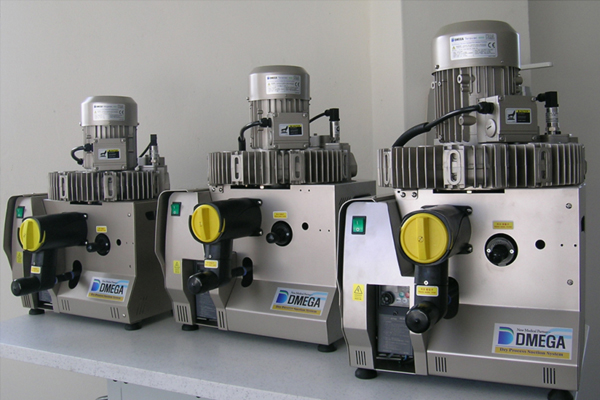
- Dry suction device for dental clinics that generate vacuum pressure through compression of air
- Purpose of use
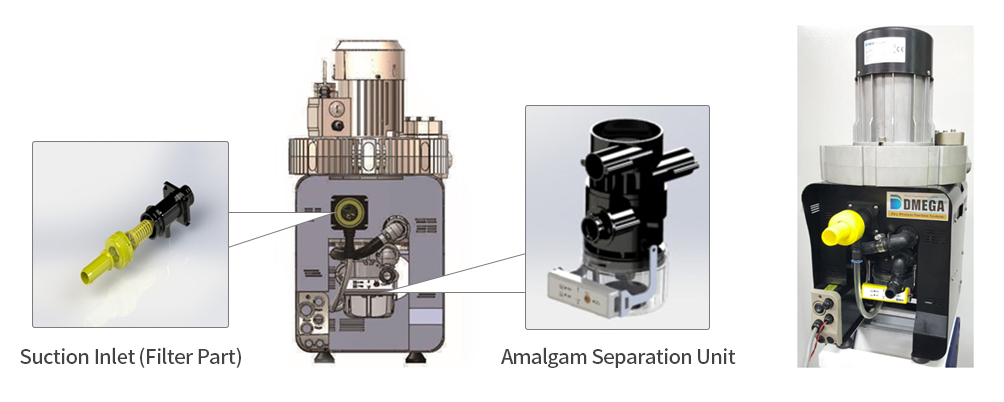
- A separator single-body type that does not need a connection to water in order to form a vacuum pressure, the device uses the vacuum pressure of air generated by a high-speed motor to completely separate air from blood, cut pieces of teeth, amalgam, etc. at a unit and chair while enabling residual water and solids to be thrown away via a connection to a drain or stored in a separate container.
[Chair Suction Unit for medium- to large-sized dental clinics, capable of connecting 1 to 6 chairs by the embedded Mitsubishi inverter]
- Development background
- Dental amalgam wastes generate both liquid wastes such as water and blood and solid wastes including amalgam metals, andamalgam remnants also remain in liquid wastes, possessing a potential risk to the environment. To solve such environmental issues, Megavac 2000A, which applies the Amalgam Separator using cyclone filtering of the vacuum suction method to separate and collect amalgams, has been developed and produced, and the product has been designed to maintain the amalgam recovery performance of more than 95% in accordance to ISO 11143 standard.